


Meet ALICE
 ALICE® stands for Asset Limited, Income Constrained, Employed — households that earn more than the Federal Poverty Level but not enough to afford the basic cost of living in their community.
ALICE is not a small group of people. ALICE is our neighbors, coworkers, friends, and family members.
These are the people who educate our children, care for our loved ones, keep businesses running, stock shelves, deliver services, and make our communities work every day. They are employed—often working one, two, or even three jobs—but still struggle to afford essentials like housing, childcare, transportation, food, healthcare, and utilities.
Many ALICE households earn too much to qualify for public assistance, yet not enough to achieve financial stability.
When income falls short of expenses, families are forced to make impossible choices:
- Pay rent or afford quality childcare
- Fill a prescription or repair the car
- Buy groceries or keep up with utility bills
These decisions may solve immediate needs, but they can create long-term challenges that make it harder for families to move forward.
During the COVID-19 pandemic, many ALICE workers were recognized as essential—but the reality is they were struggling long before and continue to face financial pressure today.
At United Way of Pierce County, we believe hardworking families should have the opportunity not just to survive, but to thrive. That’s why we are focused on helping ALICE households build financial stability through access to resources, support systems, and pathways to long-term economic mobility.
Because when ALICE families succeed, our entire community is stronger.
2026 ALICE Town Hall
ALICE in Focus: Children update is now live- click here for more information

ASSET LIMITED
ALICE has no safety net
for emergencies

INCOME CONSTRAINED
ALICE's income falls short of
basic necessities

EMPLOYED
ALICE is working, but can't
afford the cost of living
Counties are the core geography for ALICE data: They reveal variations often masked by statewide averages, and the data is reported regularly and reliably.
Use the tool below to see an overview of financial hardship, county by county. The County Profile highlights key aspects of county economies across the state, including details related to county demographics, the cost of living, and the labor landscape.
ALICE in Washington: Understanding Financial Hardship Beyond Poverty
One in Three Washington Households Struggled to Afford the Basics in 2024
In 2024, 10% of Washington households lived below the Federal Poverty Level (FPL). But poverty statistics tell only part of the story.
An additional 27% of households earned too much to qualify as living in poverty, yet still could not consistently afford housing, child care, food, transportation, health care, and other basic necessities. These households are known as ALICE:
Asset Limited, Income Constrained, Employed.
Together, households living in poverty and ALICE households represent 37% of all Washington households.
Washington Households in 2024
- 63% Above the ALICE Threshold
- 27% ALICE
- 10% Living in Poverty
Total Washington Households: 3,154,247
Source: ALICE Threshold, 2010–2024; U.S. Census Bureau, American Community Survey, 2024.
What Does It Mean to Be ALICE?
ALICE households work hard but still struggle to make ends meet.
They often face impossible choices every month:
- Paying rent or buying groceries
- Filling a prescription or paying the utility bill
- Living closer to work or finding more affordable housing farther away
- Repairing a car or paying for child care
Many have little or no savings to cover unexpected expenses like a medical emergency, job loss, or vehicle repair.
These families are not rare. They live in every community and include many of the people who keep our communities running every day, including:
- Child care providers
- Restaurant workers
- Retail cashiers
- Personal care aides
- Delivery drivers
- Bank tellers
- Hospitality workers
Despite working full-time, many simply cannot earn enough to cover the true cost of basic living expenses.
The Federal Poverty Level Doesn't Tell the Full Story
The Federal Poverty Level was developed in the 1960s and has changed very little since then.
Today, it fails to account for:
- Regional differences in the cost of living
- Rising housing costs
- Child care expenses
- Health care costs
- Transportation
- Technology needed for work and school
Because eligibility for many public assistance programs is tied to the Federal Poverty Level, many ALICE households earn too much to qualify for help—even though they still struggle every month.
In 2024, the Federal Poverty Level was:
- $15,060 for a single adult
- $31,200 for a family of four
The Real Cost of Making Ends Meet
The ALICE Household Survival Budget measures what it actually costs to cover only the basics in each county.
For a Washington family of four (two adults, one infant, and one preschooler), the annual Household Survival Budget in 2024 was:
$109,560
By comparison:
- Two full-time workers—one employed as a cook and one as a bank teller—earned a combined $78,580 annually.
- The Federal Poverty Level for that same family was only $31,200.
The gap between wages and the actual cost of living leaves many hardworking families unable to achieve financial stability.
Why the ALICE Data Matters
The ALICE framework provides a more accurate picture of financial hardship by considering:
- Household income
- Family size
- Local cost of living
- County-specific expenses
Rather than relying solely on outdated federal poverty guidelines, the ALICE Threshold measures whether families can truly afford the essentials needed to live and work.
Creating Lasting Solutions
There is no single reason families experience financial hardship, and there is no single solution.
While emergency food, housing assistance, and utility support help families weather immediate crises, lasting financial stability requires broader community action.
Long-term solutions include:
- Affordable housing
- Accessible child care
- Stable employment with livable wages
- Workforce development
- Reliable transportation
- Strong community partnerships
- Public policies that reflect today's cost of living
At United Way of Pierce County, we believe every family deserves the opportunity not just to survive—but to thrive. Understanding the realities facing ALICE households helps guide investments, partnerships, and solutions that create lasting economic mobility for our community.
Source: United For ALICE, ALICE in Washington 2024 Report; U.S. Census Bureau American Community Survey (2024); Bureau of Labor Statistics Occupational Employment Statistics (2024).
ALICE IN PIERCE COUNTY
ALICE is an acronym for Asset Limited, Income Constrained, Employed — households that earn more than the Federal Poverty Level, but less than the basic cost of living for the county. While conditions have improved for some households, many continue to struggle, especially as wages fail to keep pace with the rising cost of household essentials (housing, child care, food, transportation, health care, and a basic smartphone plan). Households below the ALICE Threshold — ALICE households plus those in poverty — can’t afford the essentials.
Pierce County at a Glance
The 2024 ALICE data provides a snapshot of the financial realities facing households across Pierce County.
|
2024 Demographics |
|
|---|---|
|
Population |
941,170 |
|
Total Households |
362,111 |
|
Median Household Income |
$100,529 |
|
Labor Force Participation Rate |
66% |
Financial Hardship in Pierce County
- 28% of households are ALICE (Asset Limited, Income Constrained, Employed)
- 9% of households are living below the Federal Poverty Level
- 37% of Pierce County households are living below the ALICE Threshold
How Pierce County Compares to Washington State
|
Pierce County |
Washington State |
|
|
Median Household Income |
$100,529 |
$99,389 |
|
Labor Force Participation |
66% |
65% |
|
ALICE Households |
28% |
27% |
|
Households in Poverty |
9% |
10% |
|
Households Below the ALICE Threshold |
37% |
37% |
Although Pierce County's median household income is slightly higher than the state average, more than one in three households still struggle to afford the basics. Many working families earn too much to qualify for assistance but too little to cover essential expenses such as housing, child care, transportation, food, and health care.
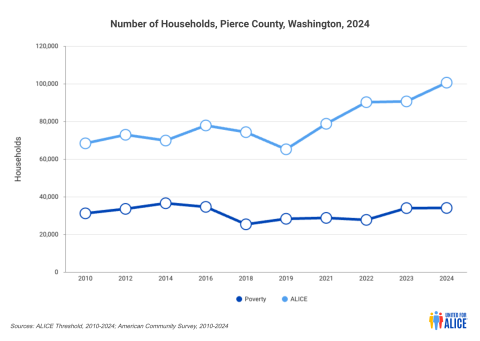
Financial Hardship Has Changed Over Time in Pierce County
As circumstances change, households may find themselves below or above the ALICE Threshold at different times. Use the buttons below to switch between ALICE data over time by number and percentage.
Financial Hardship is Not Equally Distributed
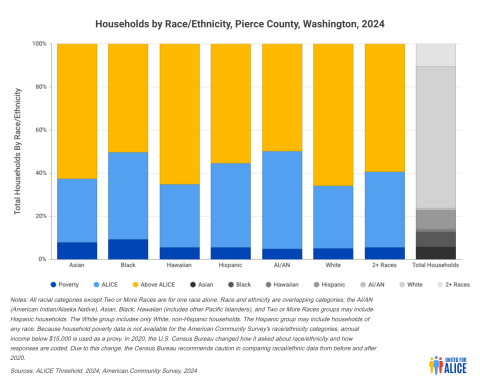
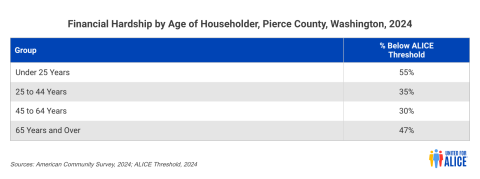
By total number, groups with the largest population of households below the ALICE Threshold tend to also be in the largest demographic groups. However, when looking at the proportion of each group that is below the ALICE Threshold, it is clear that some groups are more likely to be ALICE than others.
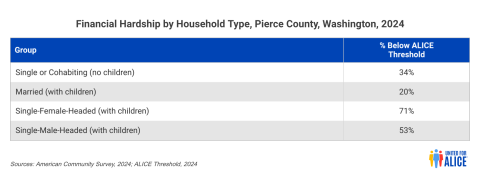
There were also differences in financial hardship by household type and age of householder.
The Cost of Basics Outpaces Wages
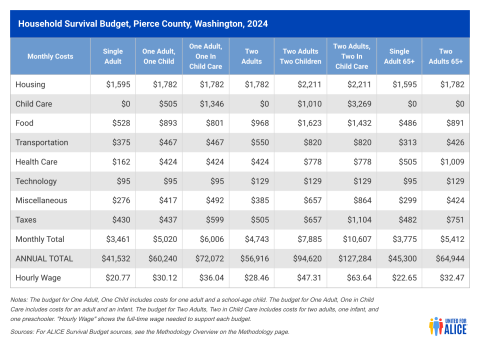
The Household Survival Budget reflects the minimum cost to live and work in the current economy and includes housing, child care, food, transportation, health care, technology, and taxes. It does not include savings for emergencies or future goals like college or retirement. In 2024, household costs in every county in Washington were well above the Federal Poverty Level of $15,060 for a single adult and $31,200 for a family of four.
Read the full Pierce County Report here.